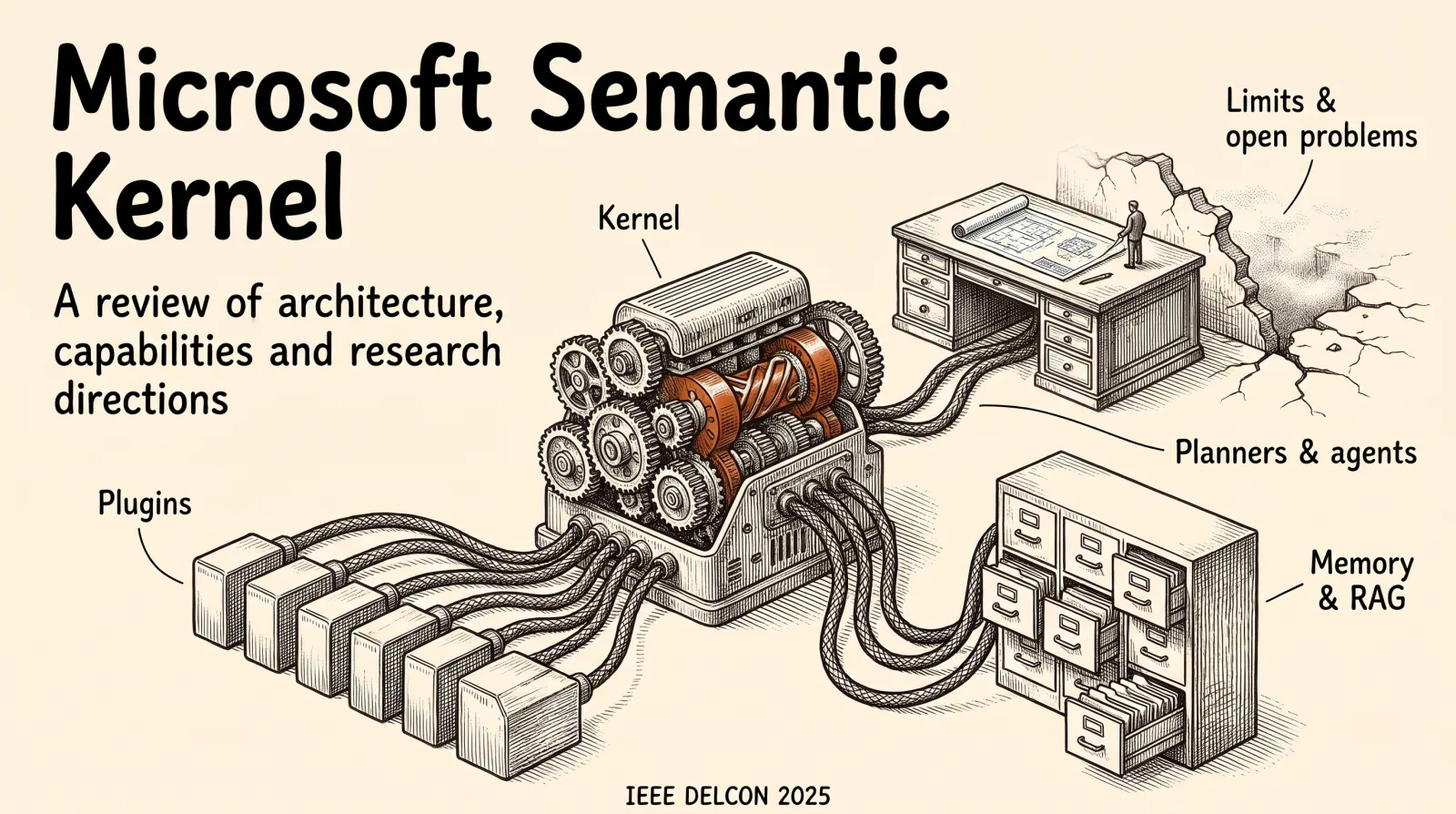
A Comprehensive Review of Microsoft Semantic Kernel: Architecture, Capabilities, and Research Directions
Published (IEEE)A peer-reviewed review of Microsoft Semantic Kernel: how it handles plugins, planners, agents and memory, and where it falls short. IEEE DELCON 2025.
Role
Co-author, with Angel Gupta. Presented the review at IEEE DELCON 2025.
Timeline
IEEE DELCON, New Delhi, October 2025
Authors
Angel Gupta, Mohit Goyal
Technologies
Semantic Kernel · AI orchestration · agent frameworks · RAG · LLMOps · enterprise AI
This paper reviews Microsoft Semantic Kernel, an open-source SDK that connects language models to ordinary C#, Python and Java code. It explains how the framework is built, what it is used for and where it hurts. If you are choosing an orchestration layer for an enterprise agent, it gives you one organized account in place of scattered docs and blog posts.
- 2025 IEEE DELCON, New Delhi
- Peer reviewed, in IEEE conference proceedings
- 3 languages covered: C#, Python and Java
What Semantic Kernel is
A language model on its own cannot read your database, call your internal API or remember last week's support ticket. Semantic Kernel (SK) is the layer between the model and your code. Your code exposes functions, the model chooses which to call, and SK runs them and hands the results back. It works with hosted and self-hosted models through one interface.
Microsoft built it for its own copilot products, and large companies use it for internal tools. The authors start from a gap: despite that use, little academic writing describes how SK is put together or what it costs you to build on it.
What the review covers
- Kernel orchestration. The kernel is a container that holds the AI services and plugins. For each call it picks a service, builds the prompt, parses the reply and fires hooks for logging. Filters run before and after a call, for example to strip personal data from a prompt before it reaches a hosted model.
- Plugins and functions. Plugins wrap APIs, databases and your own code, so a model's output can trigger a real action.
- Planners and agents. A planner turns a request like "draft a follow-up to my newest lead" into a chain of plugin calls, with no workflow written in advance. The agent framework goes further: agents that loop, share state and hand work to each other. At the time of writing, the paper notes, this part was still marked experimental.
- Memory and RAG patterns. Embeddings and vector stores let an app pull in its own documents and past conversations, so answers rest on company data and not only on what the model learned in training.
- Enterprise use. Cases include a helpdesk run by several cooperating agents, contract and document review, plain-language access to reporting data, and search across internal sources.
- Comparison. SK is set against LangChain, and in the talk against LlamaIndex too. The reading is that SK suits long-lived enterprise apps that need governance and accept more setup, while LangChain suits fast experiments.
Limits and research directions
The review names costs as well as strengths:
- The pieces (kernel, plugins, planners, memory, agents) have to be understood together, so the learning curve is steep.
- Multi-agent runs are non-deterministic and spread across services, and tooling to trace them is thin.
- The API changes quickly, with breaking changes between releases and experimental features that may be dropped.
- Latency, context size, bias and cost come from the underlying model, and SK cannot fix them.
- Filters help, but prompt injection is still open, and how well they protect depends on how the developer wires them.
Proposed changes and open questions
The authors propose five changes. An observability layer with distributed tracing for agent workflows. An anti-corruption layer that shields application code from SDK changes. Hybrid planning, where fixed rules handle routine tasks and the model is kept for open-ended ones. A stronger RAG pipeline with hybrid search, re-ranking and context compression. A shared library of responsible-AI filters.
They also list open research questions: how hybrid planning compares with model-only planning, how teams debug agent systems in practice, interoperability standards between frameworks, what vendor lock-in costs, and patterns for responsible AI at the orchestration layer. These are proposals backed by analysis, not measured results.
My contribution
Read the paper
This page is a summary in my own words and does not host the paper. The full text is in the IEEE conference proceedings:
Cite
@inproceedings{gupta2025semantickernel,
  title     = {A Comprehensive Review of Microsoft Semantic Kernel: Architecture, Capabilities, and Research Directions},
  author    = {Gupta, Angel and Goyal, Mohit},
  booktitle = {2025 IEEE DELCON},
  year      = {2025},
  address   = {New Delhi, India},
  doi       = {10.1109/DELCON68055.2025.11400282}
}