AoT-BTS: An Explainable Age-of-Trust Based Behavioral Scoring Framework for Real-Time Zero Trust Enforcement using SDN
Research Square preprintAoT-BTS scores network behavior with decaying trust: 98.31% accuracy, 0.32% false positive rate and 17.31 ms p99 enforcement latency. First author.
Role
First and corresponding author. Led the design, experiments and writing at Bharati Vidyapeeth's College of Engineering (BVCOE), advised by Prof. Tiwari.
Timeline
Research Square, May 2026
Authors
Mohit Goyal, Ananya Singh, Shreya Soni, Shaurya Khatri, Prof. Mohit Tiwari
Technologies
Key Metrics
The finding
AoT-BTS gives each network entity a trust score that decays over time, and turns the score into one of three actions on a software-defined network. On the CICIoT2023 dataset (1,629,471 flows) it reaches 98.31% accuracy and a 0.32% false positive rate. In live Mininet tests (Mininet emulates a network on one machine) the p99 enforcement latency is 17.31 ms. The p99 is the 99th percentile: 99% of the 1,000 test flows were enforced within that time. Mean time to detection falls by 40% against a static threshold (3.4 min against 5.7 min). Its accuracy equals plain XGBoost. The gains are in detection time, graded responses and explanations. The paper is a preprint and has not been peer reviewed.
The problem
Zero trust means "never trust, always verify": every request is checked, not only the first. A software-defined network (SDN) lets a central controller set forwarding rules, so it can enforce those checks in real time.
The paper names four gaps. Most zero-trust work is theory with little empirical testing. There are no standard metrics for detection time, enforcement latency or generalization. Many trust engines are black boxes that cannot justify a denial. Simulation testbeds model only binary firewall rules, not graded responses. The paper adds a fifth idea: trust should age. A device that behaves well now may be compromised later, and a static score cannot show that.
Threat model
The attacker has network access through a compromised insider, stolen credentials or an outside exploit. The attacker can scan, inject traffic, replay credentials and move sideways. The attacker does not know the model parameters, the thresholds or the SHAP weights. The decision point, the policy administration point and the ML service are trusted. The network is the untrusted plane.
What we did
The pipeline
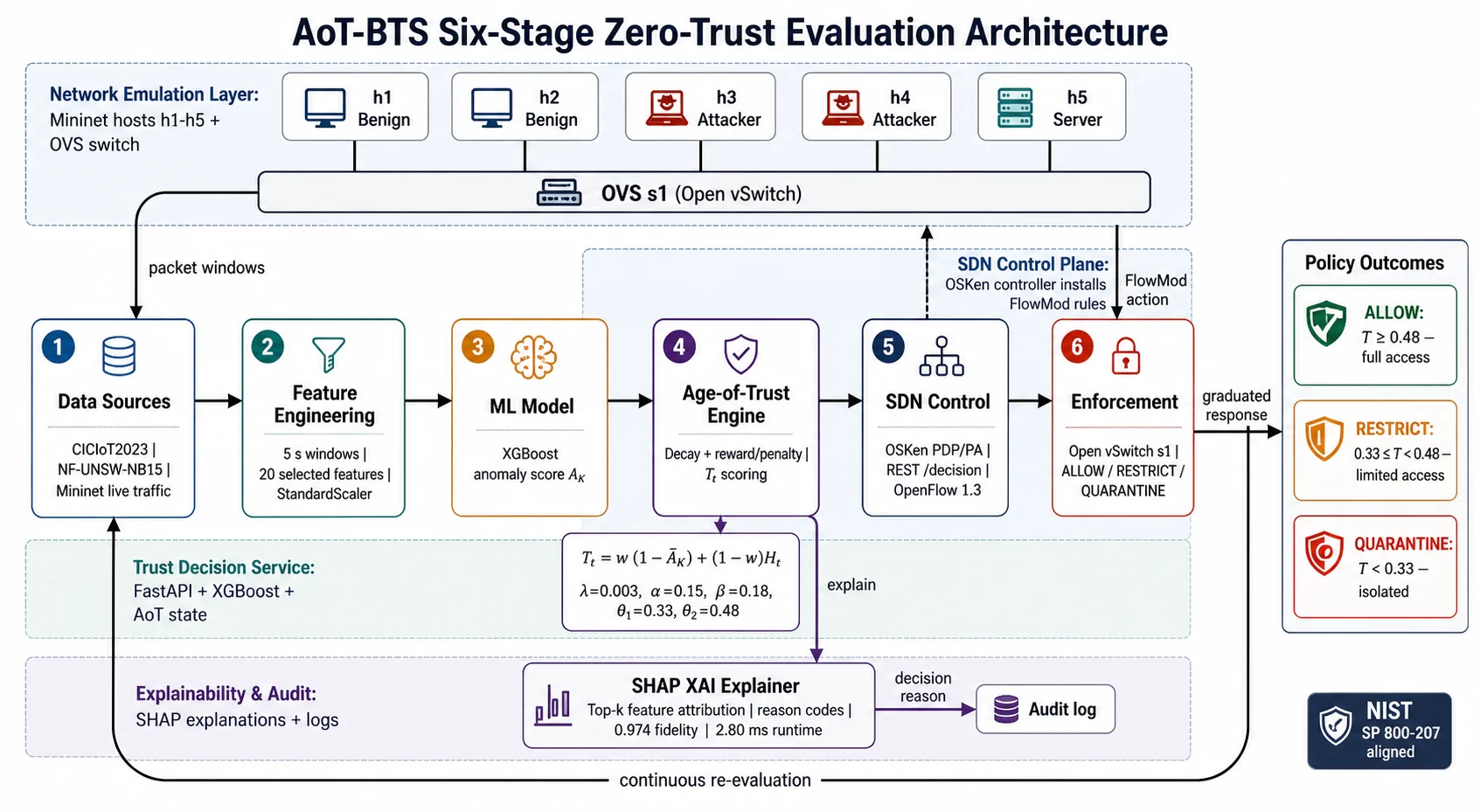
AoT-BTS is a six-stage pipeline.
- The main test uses CICIoT2023 (105 real IoT devices, 33 attack types, 97.7% attack flows). NF-UNSW-NB15 (5.4% attacks) is a second check.
- Features come from NetFlow records in 5-second windows. They are scaled, then reduced to 20 with mutual information, a score of how much each feature tells about the label. SMOTE, a method that adds synthetic examples of the rarer class, rebalances classes at 1 to 5.
- XGBoost, a model built from many small decision trees (150 trees, depth 4), gives an anomaly score between 0 and 1. A temperature setting of 4.0 softens over-confident scores.
- A FastAPI service, the trust engine, keeps state per entity: trust score, age counter and anomaly history.
- An OSKen controller turns scores into OpenFlow 1.3 rules, with a 50 ms timeout and 3 retries. The SDN controller is the program that sets forwarding rules on the network's switches. OpenFlow is the protocol it uses to program them.
- Open vSwitch, a software switch, applies one of three actions. ALLOW forwards traffic. RESTRICT rate-limits to 10 packets per second. QUARANTINE drops traffic.
The Age-of-Trust idea
Trust decays over time, rises slowly with good behavior and drops fast on bad behavior. In the model, trust decays exponentially when there is no good news: T(t) = T0 * exp(-lambda * t), with lambda = 0.003 chosen by grid search. The half-life is about 231 decisions. In use, a recurrence updates a history value H at each decision. It shrinks by the decay factor, rises by 0.15 after normal behavior and falls by 0.18 after an anomaly. The penalty is larger than the reward on purpose: trust is harder to gain than to lose.
The final score mixes the model's current anomaly score with this history: T = 0.45 * (1 - anomaly) + 0.55 * H. Two thresholds set the action. At or above 0.48 the entity is allowed. Below 0.33 it is quarantined. In between it is restricted. A margin of 0.02 stops flicker. An entity in RESTRICT needs 0.50 to move back to ALLOW and falls below 0.31 to be quarantined.
Explanations
SHAP, a method that splits a model output into per-feature shares, explains each decision. The paper reports that 6 of the 20 features reproduce 90% of the model's predictions, with a fidelity of 0.974 (R2).
Results
Table II of the paper, on CICIoT2023. MTTD is mean time to detection. Avg T is the average trust score.
| Method | Accuracy | False positive rate | MTTD (min) | Avg T |
|---|---|---|---|---|
| Static Threshold | 97.1% | 1.85% | 5.7 | 0.35 |
| Isolation Forest (as reported) | 94.2% | 3.1% | 12.4 | N/A |
| LSTM Autoencoder (as reported) | 97.8% | 1.2% | 6.5 | N/A |
| XGBoost (no AoT) | 98.31% | 0.32% | 5.8 | 0.28 |
| AoT-BTS | 98.31% | 0.32% | 3.4 | 0.40 |
AoT-BTS matches plain XGBoost on accuracy and false positive rate. The gains are in the 40% lower detection time (3.4 min against 5.7 min for the static threshold, both on the same Mininet testbed), higher average trust, graded enforcement and explanations. The Isolation Forest and LSTM Autoencoder rows are as reported in the paper's Table II. The paper cites outside work for them and does not state that they share a split with the other rows.
Classification (Table I): true positive rate 98.27%, true negative rate 99.68%, precision 99.99%, F1 0.9912, ROC-AUC 0.9969. Of 38,042 benign records, 122 were flagged. Of the attack flows, 27,439 (1.73%) were missed, and these were mostly given RESTRICT rather than QUARANTINE.
Cross-dataset: with no retraining on NF-UNSW-NB15, decisions split 32.0% ALLOW, 52.9% RESTRICT and 15.1% QUARANTINE, with average trust 0.443 and 133 policy changes (119 on CICIoT2023).
Enforcement latency and cost: p99 enforcement latency is 17.31 ms over 1,000 live flows that include DDoS traffic. Added round-trip time averages 8.574 ms. Throughput is 7,200 requests per second against 8,500 without enforcement, a 15.2% overhead.
Explanations: SHAP takes 2.65 ms on average, and 95% of explanations take 4.60 ms or less (p95). The top features by importance are header length (0.275), inter-arrival time (0.210) and ACK flag number (0.185).
Ablation (5 trials of 1,000 decisions, paired t-tests; every component significant at p < 0.05):
| Component removed | Effect |
|---|---|
| Window smoothing (using a rolling window of recent scores, so brief bursts do not trigger quarantine) | Trust collapse, meaning almost no benign traffic is allowed: the benign allow rate falls to about 0.5%, though about 99.9% of attacks are detected |
| Penalty | Attack containment falls 6.54 points (p < 0.001), quarantine nearly disappears |
| Reward | Recovered entities stay stuck in RESTRICT (p < 0.001) |
| Recurrent feedback | About 4.95 points lower containment (p < 0.001) |
| Time decay | Significant (p = 0.008), but the effect is small in short runs |
| Hysteresis (a 0.02 margin so an entity must cross a threshold by that much to change state) | Strict thresholds with no margin: the benign allow rate collapses to about 0.5% (p = 0.002) |
Figures
Pipeline
AoT-BTS pipeline, from data ingestion to graduated enforcement. This is Fig. 1 of the preprint.
Limits
- Mininet cannot model enterprise-scale networks or wide-area latency. Physical testbed results are future work.
- Evasion and poisoning attacks were not tested. The threat model assumes the attacker does not know the model.
- A six-feature explanation reaches 90% fidelity, but top-3 fidelity is 0.298. The paper says sparse explanations alone are not enough.
- The cross-dataset check reports the mix of decisions and average trust, not accuracy. It does not show how many NF-UNSW-NB15 attacks were caught.
- CICIoT2023 is 97.7% attacks, an extreme class imbalance.
- This is a preprint, not peer reviewed.
My contribution
I am the first and corresponding author. I led the design, the experiments and the writing. The work was done at BVCOE with Ananya Singh, Shreya Soni and Shaurya Khatri, and advised by Prof. Mohit Tiwari.
Cite
@article{goyal2026aotbts,
  title   = {AoT-BTS: An Explainable Age-of-Trust Based Behavioral Scoring Framework for Real-Time Zero Trust Enforcement using SDN},
  author  = {Goyal, Mohit and Singh, Ananya and Soni, Shreya and Khatri, Shaurya and Tiwari, Mohit},
  year    = {2026},
  journal = {Research Square},
  note    = {Preprint, not peer reviewed},
  doi     = {10.21203/rs.3.rs-9722330/v1}
}